

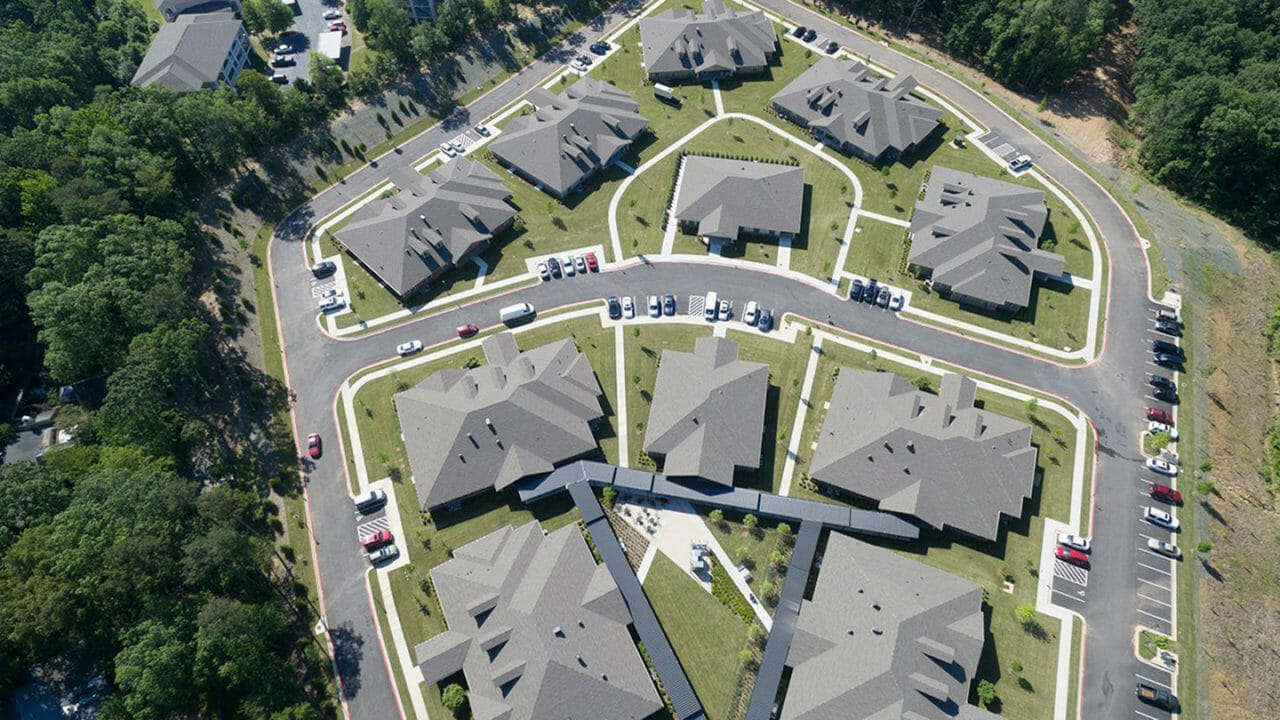
Just a dozen states have adopted any kind of incentive for nursing homes converting or designing facilities to embrace the small house model and its emphasis on private rooms, communal living and universal workers.
That’s according to a survey of providers embracing the concept, follow-up interviews in selected states and research conducted over two years by the Moving Forward Coalition.
Charlie Sabatino, a consultant on aging and law and immediate past director of the American Bar Association’s Commission on Law and Aging, presented the findings last week in an Aging IN webinar on “Creating the conditions for change” in nursing homes.
“They’ve really been bound to a hospital design model from the 1960s and 1970s,” Sabatino said. “Nursing homes are so structurally, financially, operationally — and by regulation — bound to that model that it’s not easy for them to transition.”
Sabatino and his team contacted 82 providers who had already adopted some small-house principles in whole or in part. They represented 25 states, but only those in 12 states reported a tangible financial or operational benefit for doing so.
That’s despite a recommendation from a landmark National Academies report that urged policymakers to support redesigning nursing home environments to better support quality care. There is also mounting research, including several pandemic-era studies, that skilled nursing residents fare better in the model.
The homes typically house 10 to 12 residents in private rooms, offering them shared communal space designed to function like a home. Staff typically fill multiple roles, including to guide care and interactions through a patient-directed, person-centered lens. But such configurations are expensive because they require more square footage per resident and limit facilities’ census, potentially cutting into revenues.
Sabatino said the research found only six states had begun to prioritize the small house model with quality incentive programs tied to the use of private rooms and/or private bathrooms. Because they’re typically folded into complex quality rate calculations, Sabatino said, those incentives can range from an estimated $0.50 per resident day up to $20 to $30 per resident day in Ohio.
But even a $5 daily rate add-on in Arkansas appears to be moving the needle, with Sabatino noting that state is home to one of the largest groups of Green House-branded small homes.
“It doesn’t necessarily take a large amount, but the problem with the private room increases is that the real cost of doing this is the huge capital cost.”
Most states have not attacked the problem from that angle, though New York and Massachusetts are poised to begin offering capital loans or grants to interested nursing homes. Successful legislative efforts in each state have so far been held up by legal and regulatory concerns, however.
Sabatino also outlined several states that have adopted statutory measures that could make it easier from code and survey standpoints to remain compliant when using small house principles, such as a residential style kitchen in a space accessible to residents.
While he praised the dozen states’ measures as first steps that others should look to and learn from, Sabatino said the biggest need remains unmet.
“What’s really missing here are a whole range of incentives that states commonly use to promote other policy goals,” he said, listing options such as temporary or permanent income or real estate reductions used to boost low-income housing, energy conservation, business development and educational opportunities.
“These are common in every state,” he said. “But nobody has used them yet for incentivizing the small household model.”
Kimberly Marselas (2025, November 22). Despite success of small-house nursing home model, few states incentivize it. Retrieved from – https://www.mcknights.com/news/green-house/
